
Physics-based computational discovery
Computational drug discovery from target biology to new chemical matter.
Brandt Computational Discovery develops proprietary drug-discovery programs, collaborates with academic laboratories, and provides computational discovery services to biotechnology and pharmaceutical teams.
HUNDREDS OF MILLIONS+
Ultra-large virtual screening capability
PEER-REVIEWED
Experimental and structural validation
BROAD TARGET EXPERIENCE
GPCRs • enzymes • transporters • kinases • protein–protein interfaces
DISCOVERY MODELS
Three paths to discovery.
COMMERCIAL DISCOVERY SERVICES
Computational support for biotechnology and pharmaceutical discovery teams.
From target assessment and virtual screening through molecular simulation, hit prioritization, and lead optimization, commercial projects are structured around defined scientific objectives and deliverables.
PROPRIETARY DRUG DISCOVERY
Internally originated therapeutic discovery programs.
We apply our computational platform to identify novel chemical matter and advance selected programs toward experimental validation, intellectual-property development, partnering, and investment.
ACADEMIC RESEARCH COLLABORATIONS
Publication-driven collaborative research.
We work with experimental academic laboratories in structural biology, pharmacology, medicinal chemistry, chemical biology, and related fields on scientifically compelling discovery programs.
COMPUTATIONALLY GUIDED DISCOVERY
From virtual screening to experimentally validated hits.
Virtual Screening → Prioritized Candidates → Experimental Validation by Collaborators
Structure-based virtual screening identified candidate inhibitors that were subsequently evaluated experimentally and validated by X-ray crystallography through academic collaboration.
Published in ChemMedChem, 2026
COMMERCIAL DISCOVERY SERVICES
Commercial Discovery Services
Scoped computational drug-discovery programs designed around the scientific decision your team needs to make.
Ultra-Large Virtual Screening
Explore hundreds of millions of compounds using hierarchical structure-based screening and progressive computational refinement.
FROM $25,000
Target & Binding-Site Assessment
Evaluate target structure, binding sites, tractability, and the most appropriate computational strategy before committing to a larger discovery campaign.
FROM $2,500
Virtual Screening & Hit Discovery
Structure-based screening and prioritization of focused, proprietary, or large chemical libraries to identify candidates for experimental evaluation.
FROM $5,000
Hit Prioritization & Lead Optimization
Prioritize existing hits and chemical series using structural analysis, molecular simulation, physics-based calculations, SAR interpretation, and computational medicinal chemistry.
FROM $5,000
Fractional Computational Drug Discovery
Ongoing computational support for biotechnology teams that need modeling expertise without hiring a full-time computational scientist.
FROM $5,000 / MONTH
Defined monthly scope.
FLAGSHIP COMMERCIAL SERVICE
Ultra-Large Virtual Screening
Structure-based screening of hundreds of millions of compounds to identify chemically diverse candidates for experimental evaluation.
Target preparation → Screening strategy → Workflow validation → High-throughput screening → Progressive precision refinement → Interaction and physicochemical filtering → Chemical-diversity analysis → Expert structural review → Prioritized experimental candidates
Projects from $25,000
Final project pricing depends on library size, target complexity, receptor states, screening depth, computational requirements, and downstream analysis.
Discuss an Ultra-Large Screen
INFRASTRUCTURE & SCALE
Dedicated Computational Infrastructure
Brandt Computational Discovery maintains dedicated in-house CPU and GPU computational infrastructure for large-scale molecular modeling, virtual screening, molecular dynamics, and AI-assisted computational workflows.
This enables long-running discovery campaigns to execute on reserved hardware under direct operational control without relying exclusively on on-demand cloud computing.
Large-Scale Screening
Dedicated CPU capacity for high-throughput computational campaigns.
GPU-Accelerated Modeling
Computational resources for molecular simulation and AI-assisted modeling.
Long-Duration Workflows
Dedicated infrastructure for sustained computational discovery campaigns.
Ultra-Large Chemical Space
Workflows spanning focused libraries to hundreds of millions of compounds.
METHODS & TECHNOLOGY
Methods selected for scientific confidence, not novelty alone.
Computational approaches are selected according to the scientific question, available data, target biology, and experimental objective.
MM-GBSA & Physics-Based Rescoring
Energetic analysis used selectively alongside structural and experimental evidence.
Ultra-Large Virtual Screening
Hierarchical screening workflows spanning millions to hundreds of millions of molecules.
Binding-Site Analysis
Pocket identification, characterization, and druggability assessment.
Molecular Docking
Pose generation, binding-mode analysis, and structure-based compound prioritization.
Molecular Dynamics
Explicit-solvent simulation, conformational analysis, interaction persistence, and binding-mode assessment.
Structure Prediction & AI-Assisted Modeling
AlphaFold, Boltz-2, and related modeling approaches when scientifically appropriate.
Computational Medicinal Chemistry
SAR interpretation, analog design, property assessment, selectivity analysis, and hit-to-lead prioritization.
Free-Energy Calculations
Relative binding free-energy calculations and free-energy perturbation for analog prioritization.
Method philosophy
Physics-based first. AI-assisted where useful.
Our work is grounded in structural biology, molecular mechanics, docking, molecular dynamics, and free-energy methods. AI-based tools such as Boltz-2 and AlphaFold are incorporated selectively for structure prediction, binding-pose assessment, and hypothesis generation. Every project is tailored to the underlying biology rather than forced through a fixed computational pipeline.
PROPRIETARY DISCOVERY
Proprietary Discovery
Internally originated programs applying large-scale computational discovery to therapeutically important targets and novel chemical space.
PROPRIETARY DISCOVERY
5-HT2A Ligand Discovery
Target: Serotonin 5-HT2A receptor
Stage: Computational Discovery
An internally originated discovery program using ultra-large virtual screening and structure-based computational prioritization to identify novel chemical matter targeting the serotonin 5-HT2A receptor.
Next milestone: Experimental synthesis and pharmacological evaluation.
Selected programs
Selected Collaborative Research Programs
Examples of collaborative and research-driven discovery programs spanning structure-based design, computational screening, experimental validation, and translational research.
Publications
Selected Publications
Selected research spanning virtual screening, structure-based drug design, GPCR modeling, molecular docking, medicinal chemistry, and experimentally validated computational discovery.
Novel Inhibitors of Carbonic Anhydrase I and II Identified by High Throughput Virtual Screening and Validated by X-Ray Crystallography
Virtual screening • X-ray crystallography
Novel SGLT2 inhibitors with endothelial-protective potential: a combined computational and experimental approach
SGLT2 • computational / experimental
Tilting the Scales toward EGFR Mutant Selectivity: Expanding the Scope of Bivalent Type V Kinase Inhibitors
Kinase inhibitors • EGFR selectivity
Serotonin 2A Receptor (5-HT2AR) Activation by 25H-NBOMe Positional Isomers: In Vitro Functional Evaluation and Molecular Docking
5-HT2A • molecular docking
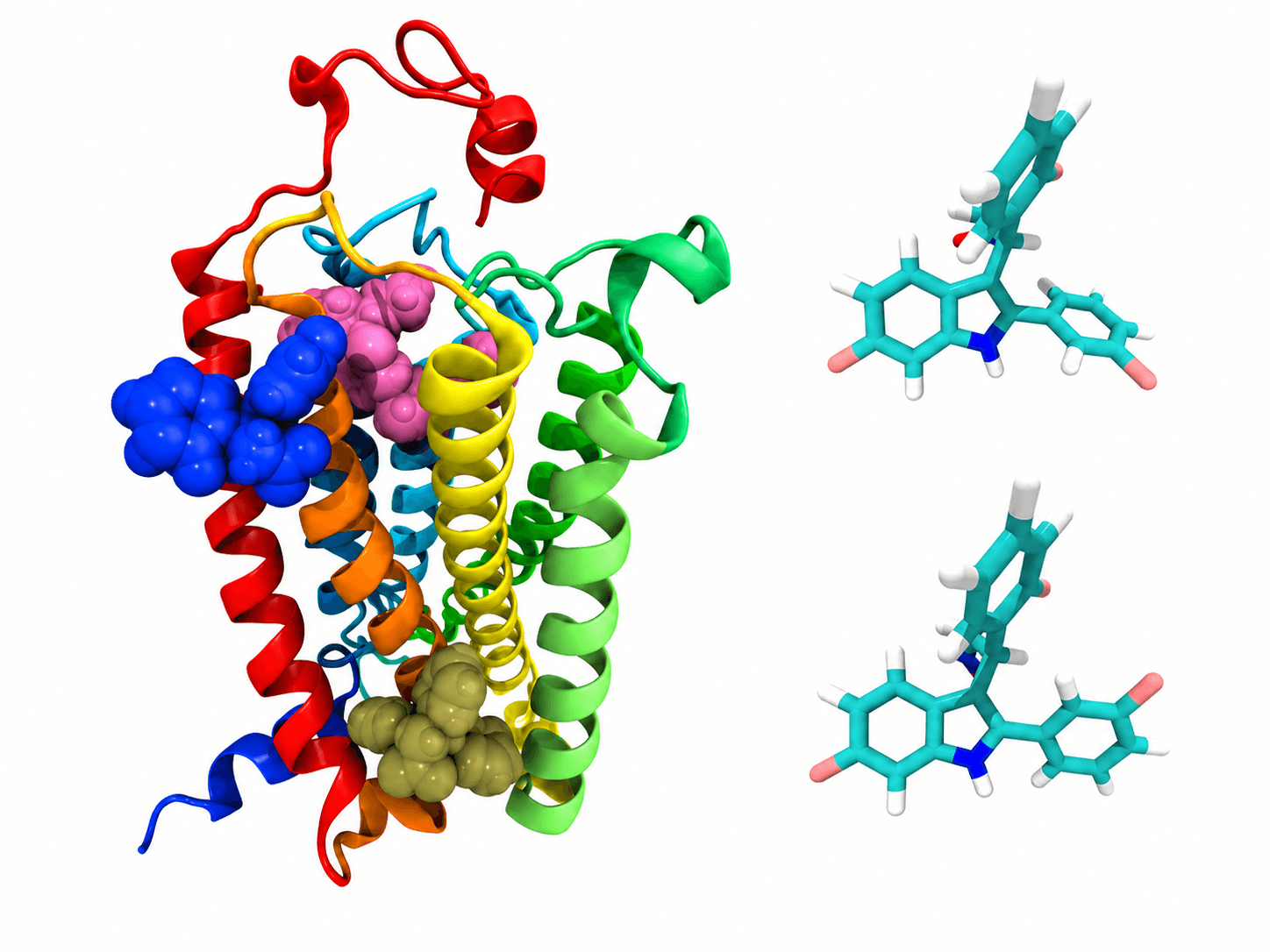
Application of Fluorine- and Nitrogen-Walk Approaches: Defining the Structural and Functional Diversity of 2-Phenylindole Class of Cannabinoid 1 Receptor Positive Allosteric Modulators
CB1 receptor • medicinal chemistry
View Full Publication Record

Founder
Asher Brandt, Ph.D.
Founder & Principal Scientist – Computational Drug Discovery
Asher Brandt is a computational chemist and molecular pharmacologist specializing in structure-based drug discovery, molecular simulation, virtual screening, and computational medicinal chemistry. His research has included peer-reviewed computational and experimentally validated studies across GPCRs, transporters, enzymes, antimicrobial targets, and protein–protein interactions. He collaborates internationally with structural biologists, medicinal chemists, pharmacologists, crystallographers, and academic research groups.
molecular simulation
virtual screening
computational medicinal chemistry